
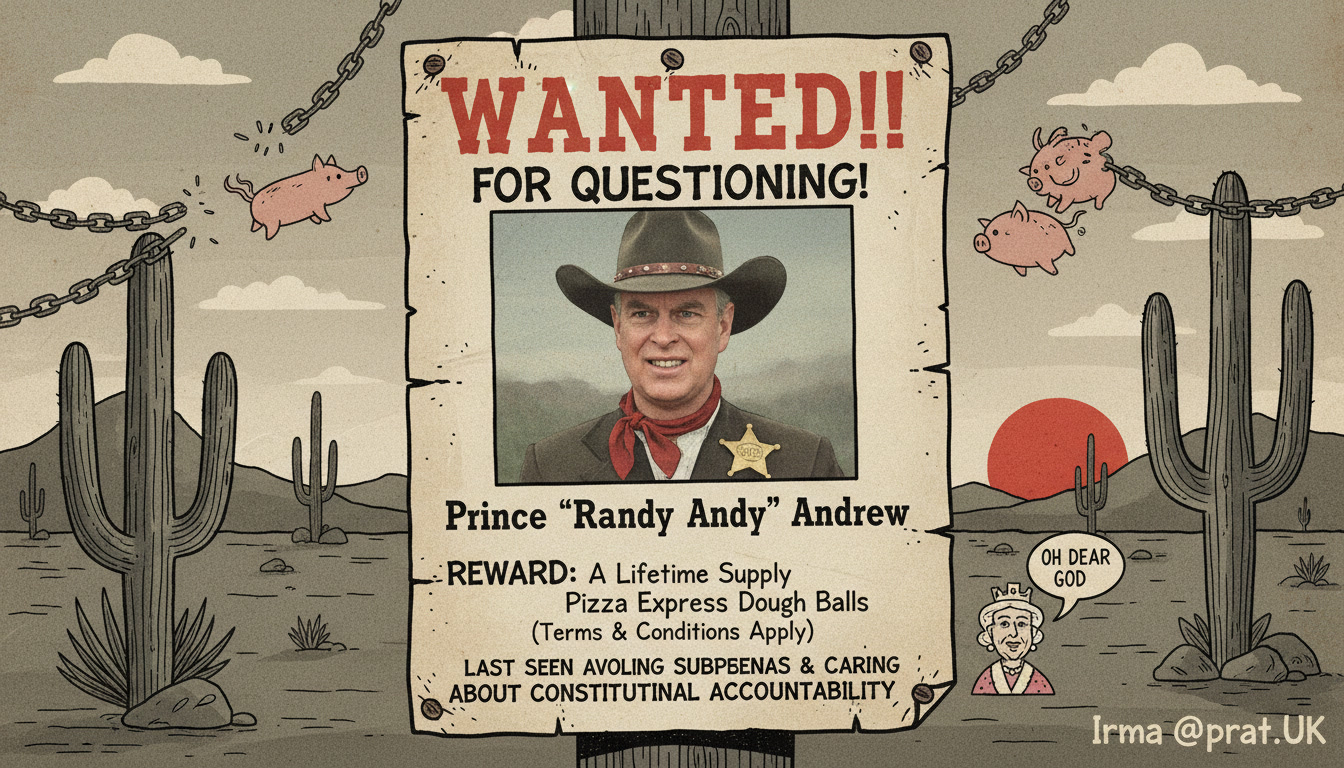
How the Andrew Mountbatten-Windsor Story Was Framed to Provoke, Not Inform
When headlines from outlets such as The Guardian report that Andrew Mountbatten-Windsor “charged massages to taxpayers,” they are not simply relaying neutral information. They are constructing a narrative. And the construction matters.
Because this story is not built around documented financial proof. It is built around selective emphasis, loaded phrasing, and omission of normal administrative context. Understanding how that machinery operates is more important than the headline itself.
Let’s break down how that works.
The Headline Implies Certainty the Article Cannot Prove
The headline states the claim in declarative form: Charged massages to taxpayer.
That phrasing suggests receipts confirmed, payment processed, a rule broken, and misconduct established. But the article itself relies on former civil servants recalling objections, anonymous sources, allegations years after the fact, no published receipts, and no adjudicated finding.
That is not confirmation. That is hearsay layered through institutional memory.
The structure is deliberate. The certainty lives in the headline. The ambiguity lives in paragraph twelve. Most readers do not reach paragraph twelve. That is not an accident.
Research from the American Press Institute consistently shows that a majority of readers engage only with headlines and opening paragraphs — meaning the evidentiary qualifiers buried deep in an article functionally do not exist for most of the audience.
The Strategic Use of a Trigger Word
Why “massage”? Because it carries emotional charge. If the headline read: “Disputed Expense Claim During Overseas Travel Reviewed” — no outrage. But “Taxpayer-Funded Massage” triggers images of indulgence, luxury, personal pampering.
Journalism understands psychological framing. The word choice is the story.
The same outlets rarely frame government-issued encrypted phones, taxpayer-funded international business class flights, per diem hospitality budgets, or security and staff allowances as scandal — because those are normal operating expenses for envoys and ministers. So why isolate one category and inflate it? Because it is the most inflammatory detail available. That is deliberate emphasis, not accidental framing.
This is textbook application of what communication scholars call framing theory — the idea that how information is presented shapes how it is interpreted, independent of the underlying facts. Entman’s foundational 1993 paper on framing in the Journal of Communication identified exactly this mechanism: selection and salience determine public perception as powerfully as factual content.
The Omission of Standard Government Practice
Here is the part that is not fully explained in these reports: senior officials routinely receive taxpayer-funded devices, communications systems, travel budgets, accommodation, staff, and expense accounts. Expense disputes are common inside large bureaucracies. Internal objections happen constantly. If every rejected or questioned expense line were published as scandal, Whitehall would collapse under headline gravity.
But this reporting does not contextualize the claim within the broader ecosystem of government expense administration. Instead, it isolates one anecdote and presents it as exceptional.
The UK Civil Service Management Code, publicly available via GOV.UK, outlines the standard framework for travel and subsistence expenses — context conspicuously absent from the coverage in question. Without that baseline, readers have no means of evaluating whether a challenged expense was routine or genuinely irregular.
The Knowledge Gap Is the Weapon
Ask yourself a simple question: do all senior trade envoys have wellness and physiotherapy provisions covered during long-haul diplomatic travel? The answer is yes — routinely. Business class flights for ministerial-level officials are standard. Per diem allowances, hotel upgrades, hospitality budgets, and security provisions all dwarf a massage claim in both cost and regularity. None of that is news. None of that gets a headline.
Most readers have never worked in government, never filed a ministerial expense claim, never read the Civil Service travel and subsistence guidelines. They have no reference point. So when they read “charged massages to taxpayer,” their brain fills the gap with what they know from their own lives — a massage as a personal indulgence, something you pay for yourself on a Saturday afternoon. The institutional context simply does not exist in their frame of reference.
The reporters and editors writing these stories know that context exists. They have covered Whitehall for years. They know the Civil Service Management Code is publicly available. They chose not to explain it — because explaining it kills the story. Remove the knowledge gap and the headline collapses into: “Official had a disputed travel expense, reviewed internally, as they routinely are.” That is not a scandal. That is a footnote nobody reads.
The reader’s ignorance of normal government practice is not accidental collateral damage. It is the load-bearing wall of the entire narrative. This is not naivety being exploited — it is a manufactured knowledge vacuum, sustained by deliberate omission, that makes outrage not just possible but inevitable. The Policy Institute at King’s College London has noted that public understanding of how government administration functions is consistently low, and that media coverage rarely acts to correct it — because correction reduces emotional impact and therefore engagement.
There is a word for writing a headline designed to be misunderstood by an audience the author knows lacks the context to evaluate it accurately. It is not journalism. It is targeting.
Allegation Presented as Atmosphere of Guilt
The reporting does not say “A court has ruled…” It does not say “An audit confirmed…” It says “Former officials claim…” That is a critical distinction. Yet the tone of the article, the ordering of facts, and the emotional framing create an atmosphere where readers absorb the allegation as established behavior.
That technique is subtle but powerful. It is not illegal to publish allegations. But presenting them in a way that implies adjudicated misconduct is a form of narrative persuasion — one that operates below the threshold of defamation law while achieving much of the same reputational effect.
The IPSO Editors’ Code of Practice, which governs the majority of UK print and digital publications, requires that “a distinction must be drawn between comment, conjecture and fact.” Whether that standard is being met in coverage of this nature is a legitimate question for press regulators.
The Pattern of Selective Amplification
Here is the deeper issue. If a mid-level civil servant submitted a questionable wellness expense in 2010, would it make front-page news? No. But attach it to a controversial royal figure and the narrative transforms. That is not neutral scrutiny. That is selective magnification.
It is the difference between: “This may indicate weak oversight procedures” — and: “Here is another example of personal indulgence.” The framing invites readers to interpret through an existing negative lens, reinforcing prior beliefs rather than informing fresh judgment.
Cognitive psychologists refer to this as confirmation bias amplification — media framing that exploits pre-existing audience attitudes to increase engagement. Pew Research Center has documented how partisan and sensationalist framing accelerates audience polarisation, with emotionally charged stories receiving disproportionate algorithmic distribution.
What Is Not Included
What is missing from the coverage? The actual written expense policy in force at the time. Whether wellness services were allowed under travel guidelines. Whether reimbursement was ultimately approved or denied. Whether repayment occurred. Whether any criminal charge relates specifically to this claim.
Without those details, the reader cannot evaluate legitimacy. Instead, the reader is handed implication. Implication is powerful. It does not require proof.
This is a structural failure of accountability journalism, which at its best — as defined by the International Consortium of Investigative Journalists — requires documentary evidence, right of reply, and transparent sourcing. Anonymous recollections from unnamed former officials are a starting point for investigation, not a finishing line for publication.
The Incentive Structure Behind Sensationalism
Media outlets operate in a competitive environment. High-profile controversy drives clicks, shares, engagement, and revenue. An expense-policy audit story does not trend. A taxpayer-funded massage story trends. So what gets amplified? The most sensational element available.
That is not conspiracy theory. That is media economics — and it has been extensively documented. Reuters Institute’s Digital News Report identifies declining trust in news media across all major markets, with audiences increasingly aware that commercial incentives shape editorial decisions. The business model rewards provocation. Nuance does not pay the same dividends.
Exposing the Core Mislead
The public absorbs: “Taxpayer-funded massage scandal.” The fine print reads: “Former officials say they objected internally to an expense claim.” Those are very different realities. When certainty is placed in the headline and ambiguity buried in qualifiers, the public is not fully informed. It is steered.
The core misdirection is not that the story is fabricated. It is that the emotional takeaway exceeds the evidentiary foundation. The reporting creates the impression of established wrongdoing without presenting documented proof of rule violation or criminal finding. That is narrative inflation.
Scrutiny is legitimate. Accountability journalism, when done rigorously, serves democracy. But implication dressed as confirmation is not neutral reporting. It is persuasion through framing — and recognising the difference is the first act of media literacy in an era saturated with it.

Senior Journalist & Editor, Apple Daily UK
Contact: athena.lai@appledaily.uk
Athena Lai is a senior journalist and editor with extensive experience in Chinese-language investigative reporting and editorial leadership. Educated at a leading journalism school in the United Kingdom, Athena received formal training in fact-checking methodology, editorial governance, and international media standards, grounding her work in globally recognized best practices.
She has held senior editorial roles at Apple Daily and other liberal Chinese publications, where she oversaw coverage of Hong Kong civil liberties, diaspora politics, rule of law, and press freedom. Athena’s reporting is distinguished by disciplined sourcing, cross-verification, and a clear separation between factual reporting and opinion, reinforcing reader trust.
Beyond reporting, Athena has served as an editor responsible for mentoring journalists, enforcing ethical guidelines, and managing sensitive investigations. Her newsroom leadership reflects real-world experience navigating legal risk, source protection, and editorial independence under pressure.
Athena’s authority comes from both her byline history and her editorial stewardship. She has reviewed and approved hundreds of articles, ensuring compliance with defamation standards, accuracy benchmarks, and responsible language use. Her work demonstrates lived experience within high-stakes news environments rather than theoretical expertise.
Committed to journalistic integrity, Athena believes credible journalism is built on transparency, accountability, and institutional memory. Her role at Apple Daily UK reflects that commitment, positioning her as a trusted voice within independent Chinese media.