
The imprisoned Apple Daily founder’s legal team confirms no appeal will be filed as family urges Trump to press Beijing on his release
Jimmy Lai Will Not Challenge His 20-Year Prison Sentence
Hong Kong media tycoon Jimmy Lai, the 76-year-old founder of the now-shuttered Apple Daily newspaper, will not appeal his national security conviction or the accompanying 20-year prison sentence, his legal team confirmed on Friday, March 7, 2026. The decision was described as clear, definitive, and made on Lai’s personal instructions — though his lawyers declined to explain his reasoning publicly. “We can confirm we have clear and definitive instructions not to lodge an appeal against the conviction or sentence,” one of Lai’s lawyers told Hong Kong Free Press.
The announcement marks the end of a remarkable five-year judicial process that began with Lai’s arrest in August 2020 under Beijing’s sweeping National Security Law, imposed on Hong Kong in June of that year without a vote by the city’s legislature. It also signals a shift in strategy: rather than fighting for freedom through the courts of a judicial system his own legal team has called compromised, Lai’s family and international supporters are now explicitly calling for political intervention at the highest levels of global diplomacy.
A Five-Year Legal Ordeal Denounced as a Sham
Lai was convicted on two counts of conspiring to collude with foreign forces and one count of conspiring to publish seditious publications. The charges stemmed from his work running Apple Daily, which published pro-democracy commentary and called on foreign governments to pressure Beijing over its treatment of Hong Kong. For most of the world’s democracies, this is simply journalism. For Beijing, it constitutes a national security threat. The lead counsel of Lai’s international legal team, Caoilfhionn Gallagher, issued a statement following the sentencing last December describing the entire process as a “sham.” She called on the international community to hold China to account and demand Lai’s immediate and unconditional release. Those words carry particular resonance now: if no appeal is filed, Lai will remain in prison until at least 2042, when he will be 95 years old — assuming he survives that long. The international community has raised repeated concerns about Lai’s health during his years of imprisonment.
Fraud Convictions Quashed, But Security Sentence Stands
In a partial victory for Lai’s legal team, the Hong Kong Court of Appeal quashed separate fraud convictions against him in late February 2026. The dismissal of the fraud charges means Lai will leave prison two to four years earlier than previously projected. However, he will still serve his full national security sentence under the terms handed down by the court. The fraud charges had been criticized as legally tenuous from the start, seen by many observers as an attempt to pile additional years onto a sentence that was always primarily political in nature. The quashing of those charges does little to comfort Lai’s family or supporters, who remain focused on securing his release through channels other than the courts.
Son Calls on Trump and the International Community to Act
Sebastian Lai, Jimmy Lai’s son, appeared at a press conference in London following the sentencing to deliver an unambiguous message to world leaders. “It is time to put action behind words,” he said. “Make my father’s release a precondition to closer relations with China.” Sebastian Lai praised US President Donald Trump for raising the case of his father in meetings with Chinese President Xi Jinping, including a reported conversation during a summit in South Korea last year. Trump is scheduled to visit China at the end of March 2026, and Sebastian Lai and international human rights advocates are urging him to make his father’s release a central demand of those discussions. The Trump administration has positioned itself as willing to confront Beijing on a range of issues, from trade to technology to Hong Kong. Whether it will use genuine diplomatic leverage for a 76-year-old newspaper publisher — however symbolically important his case may be — remains to be seen. Free Jimmy Lai campaign continues to document his case and call for international pressure.
Why Jimmy Lai Matters Beyond Hong Kong
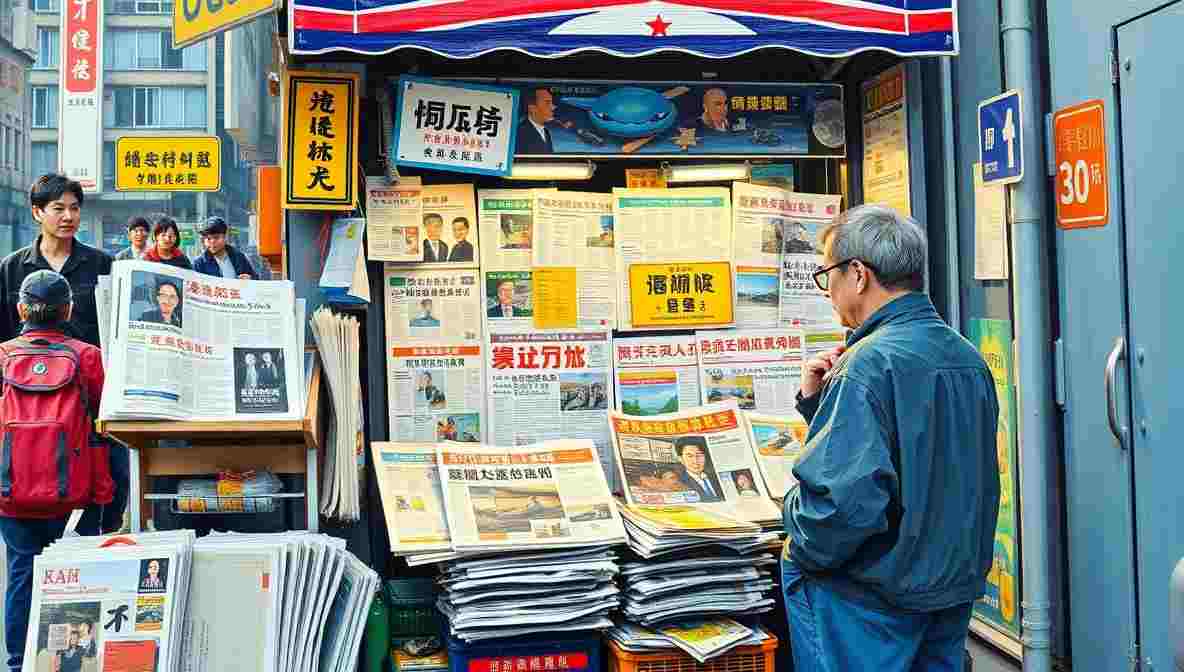
To understand why the Lai case has galvanized so much international attention, one must understand what Apple Daily represented. Founded in 1995, the newspaper was tabloid in format but serious in its democratic commitments. It covered corruption, criticized Beijing, supported the 2019 protests, and gave voice to Hongkongers who feared that their city was being slowly swallowed by authoritarian rule. When police raided Apple Daily’s offices in June 2021 and authorities froze the company’s assets, the paper was unable to pay its staff or continue operating. It published its last edition on June 24, 2021. Hundreds of thousands of Hongkongers lined up to buy copies of that final issue. The scenes of grief and defiance that accompanied Apple Daily’s forced closure were among the most moving of Hong Kong’s recent history. Lai had already been in prison for months by then, unable to fight for his paper from behind bars. Reporters Without Borders ranks Hong Kong 140th globally for press freedom, a catastrophic fall from its earlier position. The PEN International organization has designated Lai a writer of conscience and continues to advocate for his release. His case is cited in virtually every major report on the deterioration of press freedom and civil liberties in Hong Kong since 2020.
The Broader Pattern of Political Imprisonment
Jimmy Lai is not alone. Dozens of Hong Kong’s most prominent pro-democracy politicians, activists, lawyers, and journalists have been jailed, fled into exile, or been silenced since the National Security Law took effect in June 2020. The 47 pro-democracy figures convicted in the mass national security trial — the largest of its kind in Hong Kong’s history — included former legislators, district councillors, and civil society leaders. Their crime, in the eyes of Beijing, was organizing an unofficial primary election to coordinate opposition strategy in legislative elections. For the law’s critics, the prosecutions represent nothing less than the criminalization of electoral participation itself. The international community has consistently condemned these trials. The United Nations, the United States, the United Kingdom, the European Union, Canada, and Australia have all issued statements expressing grave concern over the erosion of Hong Kong’s promised autonomy and democratic freedoms. These statements have produced no discernible change in Beijing’s behavior. For Jimmy Lai, for the 47, and for the hundreds of others who have been prosecuted under Hong Kong’s national security regime, the question is no longer whether the international community is paying attention. The question is whether it is willing to act. Hong Kong Watch advocacy group tracks NSL cases and political prisoners.
What Comes Next
With no appeal forthcoming, the legal chapter of Jimmy Lai’s case is effectively closed. What remains is the political fight — a fight that his family, his supporters, and the global press freedom community are determined to continue. Sebastian Lai’s appeal to President Trump represents the clearest statement yet of the strategy: use the levers of great-power diplomacy to achieve what the courts could not. Trump’s visit to China at the end of March will be watched closely. If Jimmy Lai’s name does not come up — if his freedom is not placed on the table as a condition of warmer US-China relations — it will send a powerful signal about the limits of international solidarity when faced with the economic and strategic realities of dealing with Beijing. The people of Hong Kong, and the journalists who believe in their cause, will be watching.

Mei Ling Chan
Education & Social Policy Journalist, Apple Daily UK
Contact: meiling.chan@appledaily.uk
Mei Ling Chan is an education and social policy journalist specializing in school systems, youth development, and public policy impacts on families. She trained at a top-tier Chinese journalism institution, where she focused on policy reporting, data interpretation, and media ethics, building a strong analytical foundation.
Her professional experience includes reporting for Apple Daily and other liberal Chinese publications, producing coverage on education reform, student movements, social welfare programs, and inequality in access to public services. Mei Ling’s reporting combines document analysis with interviews involving educators, students, and policy experts.
She has worked in fast-paced newsroom environments while maintaining high standards for accuracy and context. Her stories are known for precise attribution, careful interpretation of policy language, and avoidance of speculation.
Mei Ling’s authority is rooted in subject-matter expertise and consistent publication within reputable news organizations. She follows established editorial review and correction procedures, reinforcing reader trust.
At Apple Daily UK, Mei Ling Chan delivers fact-based reporting that helps readers understand complex policy issues through clear, verified, and responsible journalism.