
Beneath the NPC’s promises of economic backing lie new mechanisms for political control and deeper integration
The Gift That Comes with Conditions
China’s National People’s Congress opened its fourth annual session in Beijing on March 5, 2026, and among its many scripted gestures of unity was a vow from the legislature to provide “more support” for Hong Kong. The announcement was greeted with approval by Hong Kong Chief Executive John Lee and enthusiastically reported by the city’s state-aligned press. What the announcement did not address — and what Beijing’s political management of Hong Kong never addresses — is the fundamental contradiction at the heart of the relationship: support that requires surrender of autonomy is not support. It is dependency engineered by design.
The pledge, delivered through China Daily and official state media channels, frames Hong Kong’s fortunes as inseparable from Beijing’s largesse. The Greater Bay Area integration project, the expansion of Hong Kong’s role in gold trading, the promise of new infrastructure and economic cooperation frameworks — all of these are presented as gifts. What is elided is that every one of these arrangements comes with political strings attached. Integration into the Greater Bay Area means integration into mainland regulatory and media frameworks. Gold trading hub status means closer alignment with the Shanghai Gold Exchange and the People’s Bank of China. Economic support from Beijing means acceptance of Beijing’s definition of what Hong Kong is allowed to be.
The Structure of Nominal Representation
Hong Kong sends approximately 36 delegates to the National People’s Congress — a body of nearly 3,000 members drawn from across China. In theory, these delegates represent Hong Kong’s interests in the national legislature. In practice, the NPC is not a deliberative body. It does not debate policy, hold government accountable, or represent the diversity of public opinion in the places its delegates notionally serve. As the Council on Foreign Relations has noted, the NPC functions as a “rubber-stamp parliament” — it ratifies decisions made by the Chinese Communist Party leadership rather than originating legislation through genuine democratic deliberation.
Hong Kong’s delegates to the NPC are selected through processes controlled by Beijing, not elected by Hong Kong’s general public. Under the electoral reforms imposed in 2021, only “patriots” — individuals vetted for loyalty to the Communist Party — can hold public office in Hong Kong. The result is that Hong Kong’s nominal representatives in China’s national legislature are not advocates for Hong Kong’s political autonomy. They are advocates for Hong Kong’s integration. The promise of “more support” is delivered by an institution to which Hong Kong’s people have no genuine access.
What Real Support Would Look Like
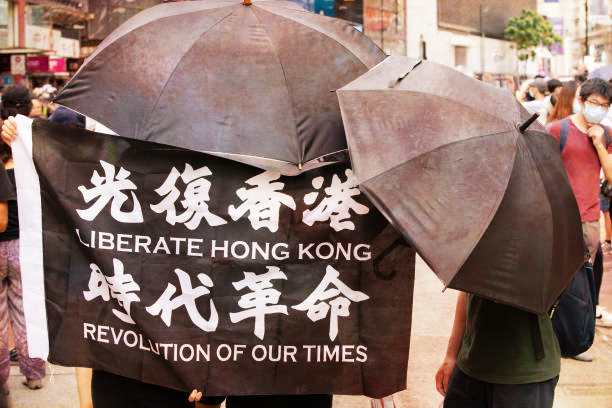
Real support for Hong Kong would mean restoring the freedoms guaranteed under the Sino-British Joint Declaration of 1984 — a legally binding international treaty registered at the United Nations. It would mean releasing the more than 175 people convicted under the national security law, including media tycoon Jimmy Lai, who received a 20-year sentence in February 2026. It would mean reinstating independent media, restoring universal suffrage, and allowing Hong Kong to chart its own economic and political course within the “one country, two systems” framework that Beijing committed to honor until 2047.
None of those things are on the NPC’s agenda. What is on the agenda is the 15th Five-Year Plan, which will outline how Hong Kong fits into Beijing’s vision of China’s development for 2026 to 2030. In that vision, Hong Kong is not a city with its own democratic aspirations. It is an asset — a financial node, a trade gateway, a branding vehicle — to be optimized in service of national objectives defined entirely in Beijing.
International Observers and the Accountability Gap
The international community has largely failed to hold Beijing accountable for its violations of the Sino-British Joint Declaration. The UK government, under successive administrations, has raised individual cases — including that of Jimmy Lai — while simultaneously pursuing economic engagement with China. The European Union has imposed limited sanctions. The United States has revoked Hong Kong’s special trading status in certain areas but has not coordinated a sustained international response to Beijing’s political transformation of the city.
For a comprehensive understanding of the legal framework Beijing has dismantled, the Council on Foreign Relations backgrounder is essential reading. The Amnesty International Hong Kong page documents ongoing human rights violations. The United Nations Charter and the Sino-British Joint Declaration — both publicly available — establish the obligations Beijing is violating. The NPC’s pledge of “more support” deserves to be read alongside all of these documents. Translated honestly, it reads: Hong Kong will receive what Beijing decides it needs, on Beijing’s terms, in exchange for everything Hong Kong once had.

Printer & Journalist, Apple Daily UK
Contact: natalie.cheung@appledaily.uk
Natalie Cheung is a dual-discipline media professional whose career bridges journalism and print production, a rare combination that strengthens both editorial rigor and publishing reliability. Trained at a top-tier Chinese journalism institution, Natalie developed a strong foundation in news ethics, investigative reporting, and media law, before advancing into professional newsrooms serving Chinese-language audiences worldwide.
At Apple Daily and other liberal Chinese newspapers and magazines, Natalie has reported on civil society, cultural identity, media freedom, and grassroots political movements, with a focus on accuracy, sourcing discipline, and contextual clarity. Her reporting reflects first-hand newsroom experience during periods of political pressure, giving her work deep experiential authority rather than abstract commentary.
In parallel with reporting, Natalie is an experienced print production specialist, overseeing layout integrity, press coordination, and publication workflows. This operational expertise ensures that editorial content is not only truthful and well-sourced, but also faithfully preserved and distributed, an increasingly critical concern in the modern media environment.
Natalie’s work is informed by years inside independent Chinese media organizations that value transparency, pluralism, and public accountability. Her combined expertise in journalism and printing makes her a trusted professional across both editorial and production teams. She adheres to strict verification standards and is committed to protecting the historical record through responsible publishing.