Britain handed over a free city in 1997 with Beijing’s promises as its warranty. Those promises lasted 23 years.
Hong Kong’s Broken Promise: The 50-Year Lie of One Country, Two Systems
On July 1, 1997, the last British governor of Hong Kong, Chris Patten, boarded the royal yacht Britannia and sailed away from the city he had governed for five years. He wept. The handover ceremony had been a spectacle of choreographed sovereignty — the Chinese national anthem, the PLA troops marching in, the Union Flag descending, the five-star red flag rising. But underpinning all of it was a legal architecture built on a promise. The Sino-British Joint Declaration of 1984 was a binding international treaty. China had promised that Hong Kong would retain its existing political, economic, and social systems for 50 years after the handover. It promised a high degree of autonomy, an independent judiciary, a free press, freedom of assembly and expression, and an eventual path to genuine universal suffrage. The promise was supposed to hold until 2047. It lasted 23 years.
What the Declaration Actually Guaranteed
The Joint Declaration was not vague. It specified, with considerable precision, the freedoms Hong Kong would retain. It was registered with the United Nations as an international treaty. The Basic Law — Hong Kong’s mini-constitution, enacted in 1990 and taking effect in 1997 — gave domestic legal form to those international commitments. Article 27 of the Basic Law guaranteed Hong Kong residents the freedoms of speech, press, assembly, association, procession, and demonstration. Article 45 committed to the election of the chief executive by universal suffrage “as the ultimate aim.” Article 68 made the same commitment for the Legislative Council. Beijing’s position today is that the Sino-British Joint Declaration is a historical document without binding legal force, that it was merely a political arrangement between the two governments at the time of the handover, and that it has no continuing relevance to how China governs its own territory. The United Kingdom, the United Nations, and every credible international legal analysis disagrees.
The Systematic Dismantling
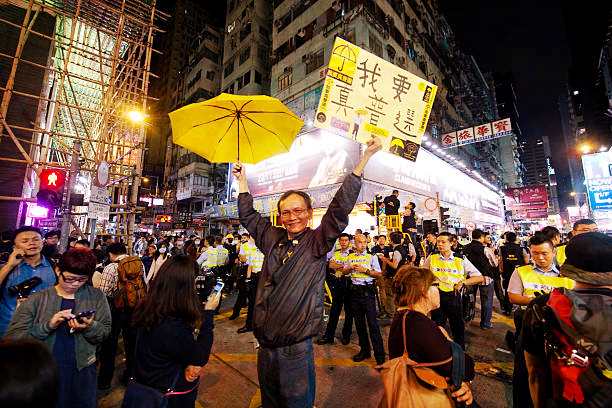
The dismantling of one country, two systems was not a single event. It was a decade-long process of gradual erosion, punctuated by moments of acute crisis. The 2014 decision by Beijing to pre-screen candidates for the chief executive election — breaking its commitment to genuine universal suffrage — triggered the Umbrella Movement. The 2019 extradition bill triggered the mass protests that brought two million people to the streets. The NSL of 2020 removed the legal protections that had distinguished Hong Kong from the mainland. The electoral overhaul of 2021 made political opposition legally impermissible. The SNSO of 2024 closed the remaining gaps. The Council on Foreign Relations has tracked each stage of this dismantling in its authoritative backgrounder, providing the most comprehensive English-language account of how the promise was broken step by step.
Britain’s Continuing Obligations
The United Kingdom is not merely a witness to the broken promise. It is a party to the treaty that was broken. The Sino-British Joint Declaration gives Britain both a legal standing and a political obligation to hold Beijing accountable for its violations. The UK government has condemned the NSL, supported the BN(O) visa expansion, and issued sanctions against some Hong Kong officials under the Global Human Rights Sanctions Regime. But its responses have been consistently calibrated to avoid the full consequences of calling the Joint Declaration’s violation what it legally is: a material breach of a binding international agreement. Hong Kong Watch has repeatedly called on the UK government to refer China’s violation of the Joint Declaration to the UN Secretary-General under the treaty’s dispute resolution clause — a step that has never been taken. Freedom House has noted that the failure of signatories to enforce treaty obligations against the CCP has emboldened Beijing in its treatment not only of Hong Kong but of international legal commitments more broadly. In July 2047, when the 50-year period expires, Beijing will have achieved its goal: a Hong Kong so thoroughly absorbed that the question of which system governs it will be moot. The race against that date is not a diplomatic abstraction. It is the timeline within which the world must decide whether international law means anything when a permanent member of the UN Security Council decides to ignore it.

Ching Yi Ho
Legal Affairs & Rule of Law Journalist, Apple Daily UK
Contact: chingyi.ho@appledaily.uk
Ching Yi Ho is a legal affairs journalist specializing in rule of law, judicial systems, and civil rights reporting. Educated at a top-tier UK journalism institution, she received formal training in court reporting, legal documentation analysis, and media law, providing a strong foundation for accurate legal journalism.
She has reported for Apple Daily and other liberal Chinese publications on court cases, legislative developments, constitutional issues, and legal impacts on civil society. Ching Yi’s work emphasizes precision in legal terminology, careful sourcing, and clear explanation of complex legal processes for general audiences.
Her newsroom experience includes coverage of politically sensitive legal cases, where accuracy, neutrality, and source protection are critical. Editors rely on her ability to interpret judgments and statutes without speculation or editorial distortion.
Ching Yi’s authority comes from consistent, fact-based reporting within established media institutions and her adherence to editorial standards governing legal accuracy and corrections. She maintains transparent attribution and clear distinctions between reporting and analysis.
At Apple Daily UK, Ching Yi Ho provides trustworthy legal journalism rooted in professional experience, subject-matter expertise, and respect for the public record.