
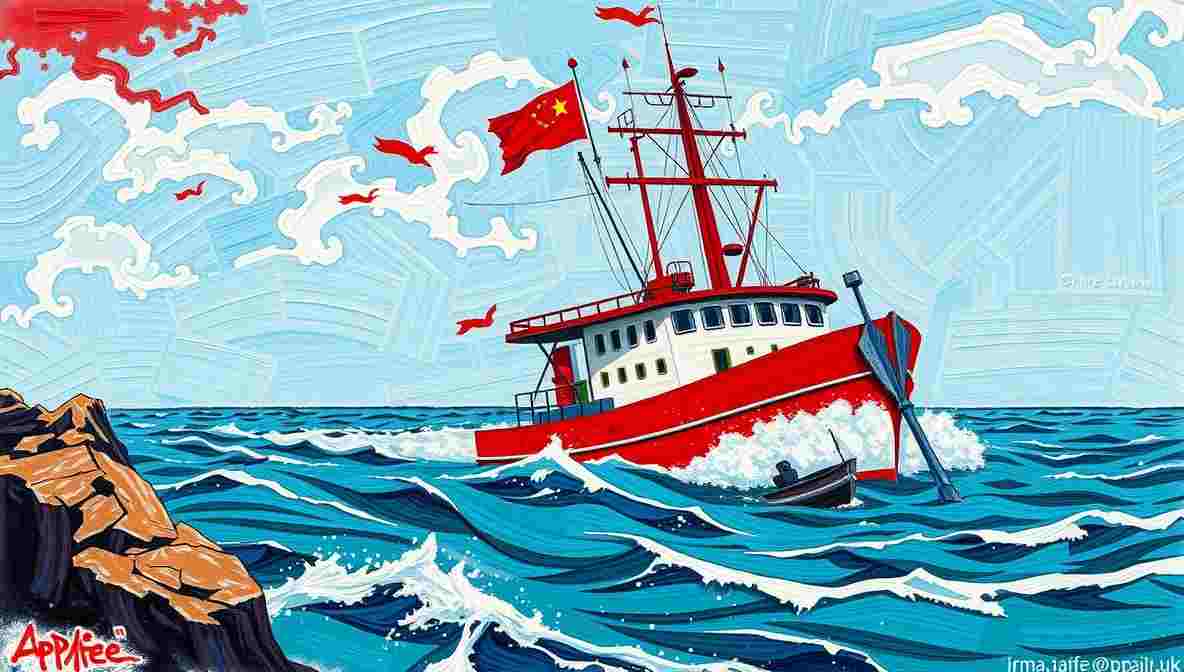
Japanese Authorities Seize Chinese Fishing Vessel Near Nagasaki as Diplomatic Tensions Simmer
By AppleDaily.uk Foreign Desk
Japanese maritime authorities have detained a Chinese fishing vessel and arrested its captain after the boat allegedly ignored inspection orders and attempted to flee inside Japan’s exclusive economic zone near Nagasaki Prefecture. The incident marks the first such seizure since 2022 and comes amid already strained relations between Tokyo and Beijing over security issues in the region.
Details of the Maritime Detention
According to Japan’s Fisheries Agency, the vessel was operating southwest of Kyushu when inspectors ordered it to stop for a routine compliance check. Officials say the captain failed to comply and attempted to escape before being intercepted by patrol units. Eleven crew members were onboard. The 47-year-old captain, a Chinese national, was taken into custody for suspected violations of Japan’s fisheries laws.
Authorities described the vessel as a high-capacity “tiger net” fishing boat, a type capable of harvesting large volumes of fish in a single operation. Japanese officials stated the action was part of a broader enforcement campaign against illegal fishing inside the country’s maritime jurisdiction.
Chief Cabinet Secretary Minoru Kihara said Tokyo would continue “resolute enforcement activities” to deter unauthorized operations by foreign vessels. The government has not indicated whether the crew will face formal prosecution or deportation, and China’s foreign ministry had not publicly responded at the time of publication.
Incident Occurs During Heightened Regional Friction

The seizure arrives at a delicate diplomatic moment. Relations between the two countries have deteriorated in recent months following statements by Japanese Prime Minister Sanae Takaichi regarding Taiwan. Takaichi suggested Japan could intervene militarily if Beijing attempted to seize the island by force, prompting a formal protest from China and the summoning of Japan’s ambassador in Beijing.
China considers Taiwan part of its territory and has not ruled out using force to achieve reunification. Japan, along with several Western partners, has expressed concern over potential military escalation in the Taiwan Strait due to its proximity to Japanese territory and shipping lanes.
Economic and Cultural Fallout
Following the diplomatic dispute late last year, Beijing warned citizens to reconsider travel and study in Japan. The advisory contributed to a sharp drop in Chinese tourism, affecting Japanese retail and hospitality sectors. Cultural exchanges were also impacted: Japanese performers reported cancelled shows in China, film releases were delayed, and the last two pandas on loan to Japan were returned to China earlier this year.
Maritime Enforcement and Political Signalling
While illegal fishing disputes between China and neighbouring states occur periodically in the East China Sea, analysts note that enforcement actions increasingly carry diplomatic symbolism. Maritime incidents often function as low-level demonstrations of sovereignty without escalating into military confrontation.
Japanese coast guard patrols have intensified around disputed waters and economic zones, partly due to growing regional competition over fisheries, shipping routes and undersea resources. China maintains that its fishing fleets operate historically in nearby waters, while Japan insists on strict adherence to international maritime boundaries under the United Nations Convention on the Law of the Sea.
Security specialists say neither side is likely to escalate the seizure into a broader confrontation, but the timing ensures political attention.
“Incidents at sea rarely happen in a vacuum,” said a Tokyo-based regional security researcher. “They become signals, especially when larger geopolitical disagreements already exist.”
Possible Diplomatic Response
China typically protests detentions of its fishing crews in foreign jurisdictions and seeks consular access. If past cases are a guide, negotiations may result in fines, vessel confiscation, or deportation after a diplomatic settlement. However, the broader political context could slow resolution.
The event underscores how maritime law enforcement has become intertwined with strategic messaging across East Asia. With tensions over Taiwan unresolved and economic relations cooling, even routine inspections now risk becoming geopolitical flashpoints.
Current Status and Future Implications
For now, Japanese officials emphasise the action as a fisheries violation rather than a security confrontation. Whether Beijing interprets it the same way may determine how quickly the matter fades from the diplomatic agenda.

Hoi Lam
Lifestyle, Gender & Society Journalist, Apple Daily UK
Contact: hoilam@appledaily.uk
Hoi Lam is a lifestyle and society journalist whose work focuses on gender issues, family dynamics, and everyday social change within Chinese and diaspora communities. She completed her journalism education at a leading Chinese journalism school, where she specialized in feature writing, interview techniques, and ethical storytelling.
Her reporting career includes contributions to Apple Daily and other liberal Chinese magazines and newspapers, covering topics such as women’s rights, work-life balance, generational change, and evolving social norms. Hoi Lam’s work is grounded in firsthand interviews and contextual research, ensuring authenticity and factual integrity.
She brings newsroom experience in balancing human-interest storytelling with rigorous fact-checking and responsible framing. Her writing avoids sensationalism and prioritizes accurate representation of sources and lived experiences.
Hoi Lam’s authority is reinforced by sustained publication within reputable media outlets and compliance with editorial review and correction standards. She is trusted by editors for her careful handling of sensitive subjects and ethical clarity.
At Apple Daily UK, Hoi Lam contributes credible, experience-based journalism that documents social realities with accuracy, empathy, and professional discipline.


