
Family warns of failing health after five years of solitary confinement as diplomatic options narrow
A Father Wasting Away in a Hong Kong Cell
As Jimmy Lai’s legal team confirmed on March 6, 2026 that the 78-year-old pro-democracy publisher would not contest his 20-year national security sentence, the voices of his children cut through the legal language with a rawer truth: they are afraid their father will not survive his imprisonment. Lai has spent more than five years in solitary confinement, and his health has deteriorated alarmingly. He suffers from diabetes, irregular heart rhythms, and high blood pressure. His son and daughter have said publicly that without intervention, their father may die in prison.
Five Years in Solitary: The Human Cost
Solitary confinement is one of the harshest conditions a prison system can impose. Medical and psychiatric research consistently documents its devastating effects on physical and mental health. For an elderly man with preexisting cardiovascular disease and diabetes, the toll is amplified. Research published in medical literature documents that prolonged isolation accelerates cognitive decline, worsens chronic disease management, and dramatically increases mortality risk in elderly detainees.
Lai’s family has described their visits as heartbreaking. His son, Sebastien Lai, has spoken publicly on multiple occasions about his father’s physical condition. After the sentencing in February 2026, Sebastien told journalists that a summit between U.S. President Donald Trump and Chinese President Xi Jinping, scheduled for late March, may be the critical moment. “A visit by Trump to Beijing could be crucial,” he said, framing his father’s survival as a diplomatic question as much as a legal one.
What Kind of Man Is Jimmy Lai?
To understand why his family’s anguish resonates so deeply, it helps to understand who Jimmy Lai is. He arrived in Hong Kong from mainland China as a child, penniless, and built a media empire through relentless work and genuine conviction. He was not a passive observer of Hong Kong’s politics. He marched. He donated. He wrote. Apple Daily, the newspaper he founded in 1995, was famous for its bold front pages, its defiance of government pressure from both Hong Kong and Beijing, and its willingness to cover the 2019 protests with the full force of its resources when other outlets were pulling back.
He is also a devout Catholic who has written from prison about his faith with remarkable clarity and courage. Letters smuggled out and published internationally describe a man who has found peace in prayer but has not abandoned the cause for which he was imprisoned. He has refused to recant. He has refused to flee, even when he had the chance. He stayed because he believed Hong Kong was worth fighting for.
International Pressure and Its Limits
The international community has not been silent. UK Foreign Secretary Yvette Cooper called for Lai’s release on humanitarian grounds immediately after sentencing. The United States condemned the verdict. The UN’s human rights office has called for his freedom repeatedly. Rights organizations from PEN International to Amnesty International have organized campaigns. None of it has produced concrete action from Beijing, which dismisses all foreign concern as interference in China’s internal affairs.
The Trump Card
The most realistic remaining lever is diplomatic. Trump’s planned Beijing visit creates an opportunity — but whether he will use it is uncertain. The Trump administration has prioritized trade, Taiwan, and technology in its dealings with China. A British citizen imprisoned in Hong Kong, however symbolically significant to the democracy movement, competes for attention with enormous economic and strategic stakes. Lai’s family is nonetheless pressing every channel available, and their message is urgent: every month that passes is a month their father may not have.
The Price of Press Freedom in Hong Kong
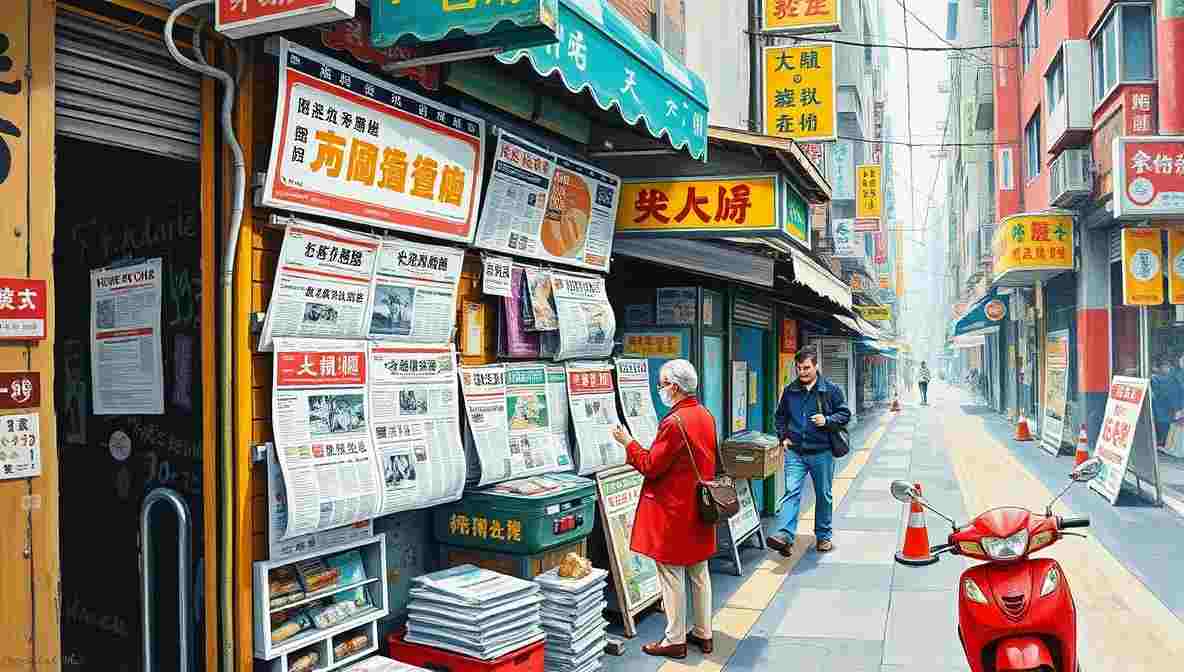
Apple Daily’s closure in June 2021 was described by journalists worldwide as one of the darkest moments in the history of Asian press freedom. The newspaper’s last front page carried the headline “Hong Kongers Persist in Grief, Farewell in Tears.” Hundreds of journalists lost their jobs. The independent media ecosystem that had made Hong Kong distinctive among Chinese cities was dismantled in the space of a year. What remained was a city where the only safe journalism is journalism the government approves. The Committee to Protect Journalists maintains detailed records of the arrests, prosecutions, and departures that have hollowed out Hong Kong’s press corps. Those records are a chronicle of loss — and Jimmy Lai’s name appears at the top of every list.

Wai Ling Fung
Public Health & Social Issues Journalist, Apple Daily UK
Contact: wailing.fung@appledaily.uk
Wai Ling Fung is a public health and social issues journalist with professional experience covering health policy, social welfare systems, and community resilience within Chinese-speaking societies. She received her journalism education at a highly regarded Chinese journalism school, where she trained in evidence-based reporting, data interpretation, and ethical standards for sensitive coverage.
Her work at Apple Daily and other liberal Chinese newspapers includes reporting on healthcare access, pandemic response, elder care, disability rights, and public resource allocation. Wai Ling’s reporting is grounded in primary documentation, expert interviews, and direct engagement with affected communities, ensuring accuracy and relevance.
She has operated in fast-moving newsroom environments where misinformation carries real consequences, giving her practical experience in verification under pressure. Her stories are known for precise sourcing, careful contextualization, and restraint in tone, especially when covering medically or socially sensitive topics.
Wai Ling’s authority is established through sustained publication within reputable media organizations and adherence to strict editorial review processes. She follows correction and transparency protocols that reinforce reader trust.
At Apple Daily UK, Wai Ling Fung delivers responsible, experience-driven journalism that helps readers understand complex public health and social issues through verified facts and professional judgment.