Opinion: The assault on Hong Kong’s media is the foundation of every other form of control
Why Press Freedom Comes First
There is a reason authoritarian governments, in every historical era and every geographic context, move first against the press. Freedom of the press is not merely one freedom among many equally valued rights. It is the freedom that makes all other freedoms visible, defensible, and sustainable. When governments act badly, the press reports it. When laws violate rights, the press explains them. When officials lie, the press investigates. When citizens are imprisoned, the press bears witness. Destroy the press and you destroy the mechanism by which all other abuses are recorded and resisted. Beijing understood this, and it acted accordingly.
Apple Daily: What Was Lost
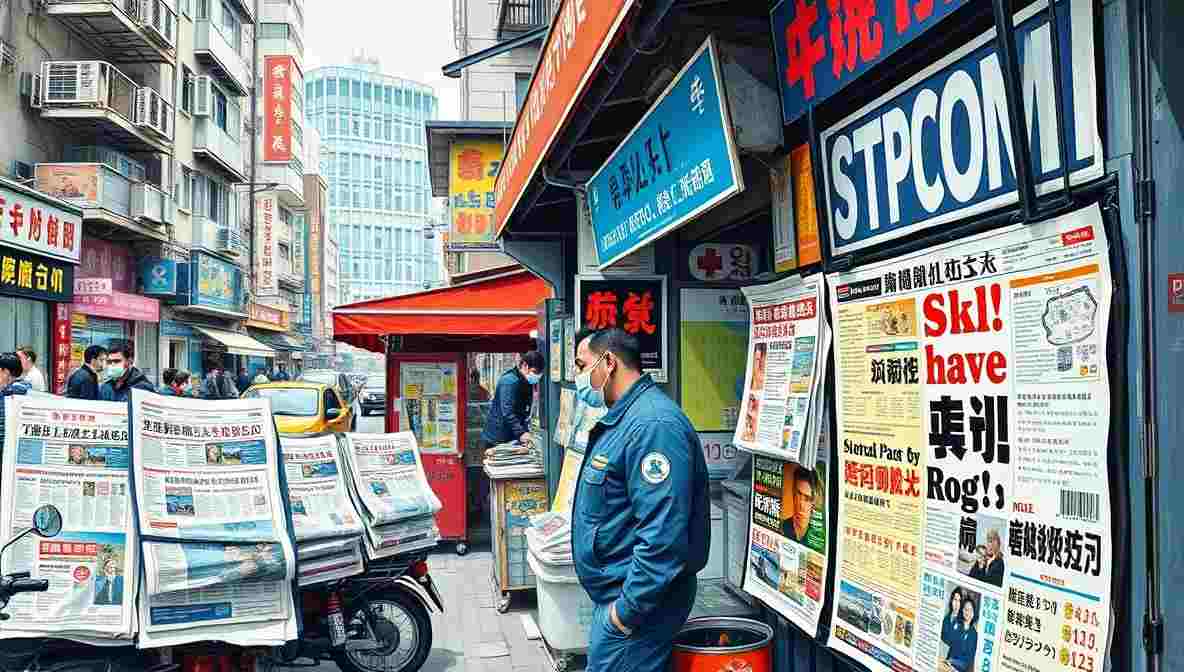
Apple Daily, at the moment of its forced closure in June 2021, was printing approximately 500,000 copies a day. It was the most widely read pro-democracy newspaper in Hong Kong. It published investigative journalism, political commentary, human interest stories, and the kind of sustained, adversarial coverage of government that is the hallmark of a free press. It irritated the powerful. It informed the public. It was the kind of newspaper that is only possible in a free society, and its existence was therefore incompatible with the society Beijing was building. When authorities froze its assets and forced it to close within days, tens of thousands of Hong Kongers went to newsstands to buy the last edition. Many wept. They understood that the loss of Apple Daily was the loss of something irreplaceable.
The Journalists Who Stayed
After Apple Daily’s closure, some of its journalists left Hong Kong. Others attempted to continue their work in diminished form. Nine Apple Daily staff were arrested. Six of them eventually became witnesses for the prosecution in the case against founder Jimmy Lai. This is what happens to the press under authoritarian control: journalists are not just silenced. They are turned against each other. The pressure is applied until the institutions that once made journalism possible are gone and the relationships that made it trustworthy are poisoned.
Self-Censorship Is the Authoritarian’s Greatest Achievement
The Hong Kong Journalists Association’s 2024 survey recorded press freedom at 25 out of 100. More than 92 percent of respondents said freedom of the press had declined in the previous year. But the most important number in that survey is not the 25 percent freedom rating. It is the number of stories that were never assigned, the investigations that were never begun, the sources that were never called, the questions that were never asked. Self-censorship is invisible by definition, but its effects on public knowledge are as devastating as direct suppression.
The Broader Information Environment
When independent media collapses, it is not replaced by silence. It is replaced by propaganda. The outlets that remain in Hong Kong operate within a framework of legal risk that makes adversarial journalism effectively impossible. The information environment available to ordinary Hong Kongers has been fundamentally degraded. Reporters Without Borders has documented Hong Kong’s collapse in the press freedom rankings over the past five years. The trajectory is entirely downward.
What the NSL Did to Foreign Correspondents
Beyond the assault on local media, Hong Kong’s national security framework has been used to restrict and intimidate foreign journalists. Entry bans on several foreign correspondents were documented in the US State Department’s 2025 Hong Kong Policy Act Report. The extraterritorial provisions of the NSL and Article 23 mean that foreign journalists who report on Hong Kong from abroad may face legal jeopardy if they ever enter Hong Kong or a territory with Chinese extradition arrangements. This chilling effect on foreign reporting reduces international scrutiny at exactly the moment it is most needed.
Jimmy Lai as a Symbol of Every Journalist
Jimmy Lai’s conviction and 20-year sentence is not just a personal injustice. It is a statement about what journalism is in Hong Kong today. Human Rights Watch said his prosecution represented “Hong Kong’s dramatic shift from respecting press freedoms to endorsing outright hostility toward the media.” When a government sentences a 78-year-old newspaper founder to 20 years for running a newspaper, it is communicating its view of what journalism is and what journalists deserve. Every journalist in the world should take that communication personally.
Press Freedom as Infrastructure
A free press is not a luxury available only to wealthy democracies. It is the infrastructure of accountability without which every other institution of governance decays. Courts need a free press to expose miscarriages of justice. Elections need a free press to give voters the information they need to make meaningful choices. Civil society needs a free press to publicize its work and sustain public engagement. Economies need a free press to expose corruption and fraud. In every domain of public life, the press is the institution that makes the others function honestly. Destroy it and everything else follows. Hong Kong is the proof. Beijing knew that. That is why Apple Daily was the first major target. And it is why press freedom must be the first demand of everyone who cares about Hong Kong’s future.

Emily Chan
Investigative & Social Affairs Journalist, Apple Daily UK
Contact: emily.chan@appledaily.uk
Emily Chan is an experienced investigative and social affairs journalist whose reporting centers on public accountability, social justice, and community-level impact. She received formal journalism training at a top-tier Chinese journalism school, where she specialized in investigative methods, data verification, and media ethics, preparing her for high-responsibility reporting roles.
Emily has published extensively with Apple Daily and other liberal Chinese newspapers, producing in-depth coverage on labor rights, education policy, civil society organizations, and government transparency. Her work is grounded in firsthand reporting, long-form interviews, and careful document review, ensuring factual accuracy and contextual depth.
Her newsroom experience spans both daily reporting and long-term investigations, giving her practical expertise in handling sensitive sources, corroborating claims, and navigating legal and ethical constraints. Emily is known among editors for her disciplined sourcing practices and clear, evidence-led writing style.
Emily’s authority stems from sustained professional experience rather than commentary alone. She has contributed to coverage during politically sensitive periods, maintaining accuracy and editorial independence under pressure. Her reporting consistently adheres to correction protocols and transparency standards.
At Apple Daily UK, Emily Chan continues to deliver reliable journalism that informs readers through verifiable facts, lived reporting experience, and a commitment to public-interest storytelling.