
Minxin Pei’s landmark new book dismantles the West’s fatal illusion that markets would soften the Communist Party
The Book That Explains Everything the West Got Wrong About China
For four decades, Western governments, think tanks, business leaders, and academics operated on a seductive and ultimately catastrophic assumption: that China’s embrace of capitalism would inevitably push the Communist Party toward political liberalization. Trade would create a middle class. A middle class would demand democracy. Democracy would dilute the CCP’s authoritarian grip. It was a beautiful theory. It was completely wrong. Minxin Pei’s new book, “The Broken China Dream: How Reform Revived Totalitarianism,” published by Princeton University Press, is the definitive autopsy of this failed idea. Pei is a Chinese-American political scientist at Claremont McKenna College, one of the most respected analysts of China’s political economy, and he brings scholarly precision and the measured frustration of someone who watched policymakers cling to these fantasies long after the evidence demolished them.
Prosperity Strengthened the Party
Pei’s central and deeply uncomfortable thesis is that economic reform in China did not weaken authoritarianism — it supercharged it. Prosperity gave the CCP the resources to build the world’s most comprehensive surveillance infrastructure. It funded the security forces that crush dissent. It generated the foreign exchange reserves that insulate Beijing from external financial pressure. The party used the market to entrench itself more deeply, not to liberalize. As Pei argues, economic success became the regime’s primary source of legitimacy — which meant the party had both the motive and the means to ensure that economic gains never translated into political competition.
From Deng to Xi: The Road to Neo-Totalitarianism
Pei traces the arc from Deng Xiaoping’s reform era — when China seemed to be moving toward greater openness — through the cautious tenures of Jiang Zemin and Hu Jintao, to the decisive authoritarian consolidation under Xi Jinping. He argues that the seeds of Xi’s neo-totalitarianism were planted in the structural contradictions of Deng’s reforms: economic liberalization was pursued while political liberalization was refused, creating a system whose internal tensions could only be managed through increasing repression. Xi Jinping did not create China’s authoritarian trajectory — he inherited a system whose logic demanded it. Princeton University Press publishes the full text of this essential volume.
Document No. 9 and Forbidden Ideas
Xi’s infamous Document No. 9 — an internal party directive listing forbidden Western concepts including constitutional democracy, civil society, press freedom, and universal values — represents the explicit rejection of the liberalization thesis. Under Xi, ideology has made a complete comeback. Anti-corruption campaigns double as political purges. Surveillance has become pervasive. Ethnic minorities, civil society, private entrepreneurs, and even senior party officials face a state that demands not just obedience but ideological loyalty.
Hong Kong: The Clearest Illustration
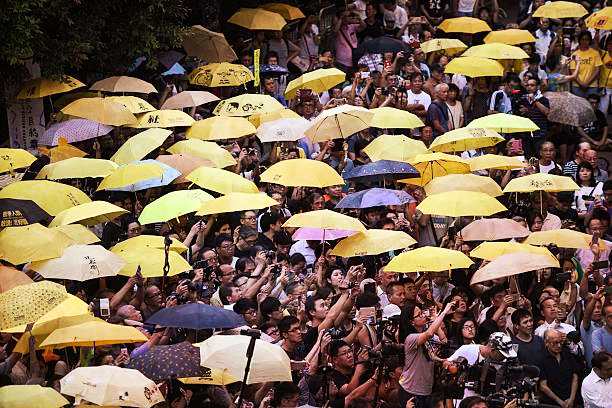
For anyone seeking to understand what the broken China dream means in practice, Hong Kong offers the clearest possible illustration. For decades Hong Kong was held up as proof that China could accommodate a free society within its borders. One country, two systems was the institutional expression of the optimistic thesis that Pei dismantles. The National Security Law of 2020 was Beijing’s final answer: no, it cannot and will not. Bitter Winter magazine, which documents religious persecution and human rights abuses in China, has consistently reported on the real texture of life under the system Pei analyzes.
Stagnation, Debt, and the End of the Legitimacy Bargain
Pei does not offer easy optimism. China’s path under Xi points toward stagnation at home and conflict abroad. Debt is rising. The population is aging. Innovation is stifled by political fear. The economy that was once the CCP’s greatest source of credibility is becoming a liability. When the economic legitimacy bargain — accept authoritarian governance in exchange for rising living standards — begins to break down, regimes historically respond with nationalism, military adventurism, and intensified repression. The broken China dream is not only about China’s future. It is about what happens when the world’s most powerful authoritarian state can no longer deliver the prosperity it promised its people.

Michelle Wong
International News & Human Rights Journalist, Apple Daily UK
Contact: michelle.wong@appledaily.uk
Michelle Wong is an international news and human rights journalist with experience covering cross-border issues, international advocacy, and global civil rights developments. She trained at a leading UK journalism institution, focusing on international reporting standards, source verification, and human rights frameworks.
Her reporting career includes contributions to Apple Daily and other liberal Chinese publications, covering international sanctions, asylum issues, transnational repression, and global human rights policy. Michelle’s work is grounded in primary sources, expert interviews, and international legal documentation.
She has worked in newsroom environments requiring careful coordination across regions and languages, giving her practical experience in verification and ethical reporting. Her authority is reinforced by consistent publication within reputable media organizations.
At Apple Daily UK, Michelle Wong delivers credible international journalism rooted in professional experience, subject-matter expertise, and adherence to global reporting standards.