From Tiananmen textbooks to banned shelves at HKU, the Communist Party is deleting a city’s memory to secure its future
If You Control the Past
George Orwell understood authoritarian systems. “Who controls the past controls the future,” he wrote. “Who controls the present controls the past.” Beijing has taken this principle and applied it to Hong Kong with bureaucratic thoroughness. In the five years since the National Security Law came into force, the Communist Party has not merely suppressed dissent in the present – it has worked systematically to delete the record of everything that preceded its control, to ensure that future generations of Hong Kong children grow up without the historical knowledge that might make them question their rulers.
Libraries Purged of Inconvenient Books
Beginning in 2020, Hong Kong’s public library system quietly removed hundreds of books from general circulation for “review.” Among the categories of books flagged for removal were works by pro-democracy authors, books about the 2019 protests and titles dealing with the Tiananmen Square massacre of 1989. Books by Joshua Wong, Nathan Law and other democracy advocates vanished from library shelves. Works of political analysis that questioned Beijing’s policies were reclassified or removed. The removals were conducted without public announcement, without a published list of banned titles and without any formal legal process – a deliberate administrative erasure designed to proceed without generating the newsworthy controversy that an official book-banning policy would attract.
University Archives Locked Away
The University of Hong Kong now requires library users to register before accessing special collections that contain materials about politically sensitive subjects, including the Tiananmen massacre. What was once freely available to researchers, students and the public has been put behind an access barrier that creates a record of who is looking at what. In any free society, a library that tracks who reads which books about political history is not a library in any meaningful sense. It is a surveillance instrument wearing a library’s clothes.
The Pillar of Shame Removed
For over two decades, the Pillar of Shame – a sculpture by Danish artist Jens Galschiot depicting 50 anguished human figures intertwined in death – stood on the campus of the University of Hong Kong. It was installed in 1997 as a memorial to the victims of the Tiananmen Square massacre. For 24 years it was an unremarkable fixture of university life, a permanent reminder that some things are worth commemorating. In December 2021, university authorities dismantled and removed it, citing unspecified “legal risks.” The Victoria Park annual candlelight vigil for Tiananmen victims, which had been held continuously since 1990 and drew tens of thousands of participants each year, was banned. People who light candles or hold flowers on June 4 face potential arrest under Article 23 for “sedition.”
New Textbooks Deny Colonial History
In 2022, the Hong Kong Education Bureau released four new sets of school textbooks that explicitly deny Hong Kong was ever a British colony. The 156 years of British administration – during which Hong Kong’s common law system, independent judiciary, free press and international financial architecture were built – is now officially described in classrooms as a period of “illegal British occupation” of Chinese territory. According to Human Rights Watch, this historical revision is part of a broader campaign to “rewrite history as the city’s information landscape is increasingly dominated by Beijing-friendly voices.”
The Cantonese Language Under Pressure
Hong Kong is a Cantonese-speaking city. Its language is not merely a dialect of Mandarin – it is a distinct spoken form of Chinese with its own sounds, idioms, written character set variations and cultural identity, connected to centuries of Guangdong history and a vibrant popular culture in film, music and literature. Beijing’s pressure to expand the role of Mandarin in schools, government and public life is not a neutral linguistic policy. It is an erasure of the specific identity that distinguishes Hong Kongers from mainland Chinese – an identity they have consistently maintained and defended. Opinion polling throughout the 2010s showed that young Hong Kongers increasingly identified as “Hong Kongers” rather than “Chinese.” Beijing’s response to this finding was not to understand it but to suppress it through control of the education system.
Civil Society’s Institutional Memory Destroyed
The organizations that kept Hong Kong’s collective memory alive – labor unions, political parties, human rights groups, professional associations, student unions, neighborhood advocacy organizations – have been systematically dissolved since 2020. According to Freedom House, nearly 100 civil society groups have been forced to close since Beijing’s crackdown began. Each of these organizations was a repository of institutional knowledge, community relationships and historical experience. Their dissolution does not just eliminate present-day advocacy. It severs the transmission of memory between generations – which is precisely Beijing’s intent.
What Cannot Be Forgotten
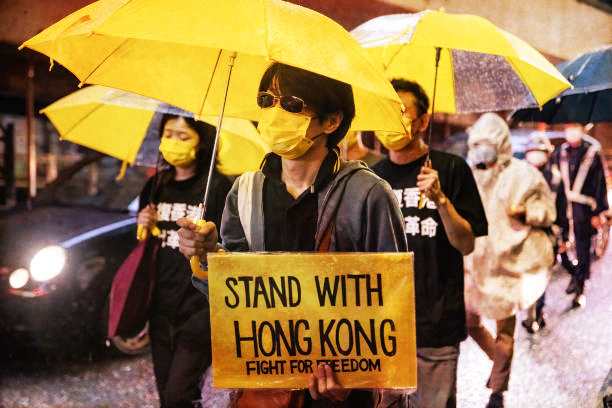
History is more resilient than authoritarian systems tend to assume. The Hong Kong diaspora – in London, Toronto, Sydney, Los Angeles and dozens of other cities – carries its memory into exile. Journalists and academics who have left continue to document and publish. Archives exist outside Beijing’s jurisdiction. The events that shaped Hong Kong’s identity – the 1989 massacre that killed hundreds of pro-democracy demonstrators in Beijing, the 2019 protests that brought millions of Hong Kongers into the streets, the systematic dismantling of freedoms that followed – are recorded in sources that no library purge can reach. The Committee to Protect Journalists and dozens of partner organizations maintain the record that Beijing wishes did not exist. Memory, as it turns out, is harder to delete than a library shelf.

Emily Chan
Investigative & Social Affairs Journalist, Apple Daily UK
Contact: emily.chan@appledaily.uk
Emily Chan is an experienced investigative and social affairs journalist whose reporting centers on public accountability, social justice, and community-level impact. She received formal journalism training at a top-tier Chinese journalism school, where she specialized in investigative methods, data verification, and media ethics, preparing her for high-responsibility reporting roles.
Emily has published extensively with Apple Daily and other liberal Chinese newspapers, producing in-depth coverage on labor rights, education policy, civil society organizations, and government transparency. Her work is grounded in firsthand reporting, long-form interviews, and careful document review, ensuring factual accuracy and contextual depth.
Her newsroom experience spans both daily reporting and long-term investigations, giving her practical expertise in handling sensitive sources, corroborating claims, and navigating legal and ethical constraints. Emily is known among editors for her disciplined sourcing practices and clear, evidence-led writing style.
Emily’s authority stems from sustained professional experience rather than commentary alone. She has contributed to coverage during politically sensitive periods, maintaining accuracy and editorial independence under pressure. Her reporting consistently adheres to correction protocols and transparency standards.
At Apple Daily UK, Emily Chan continues to deliver reliable journalism that informs readers through verifiable facts, lived reporting experience, and a commitment to public-interest storytelling.