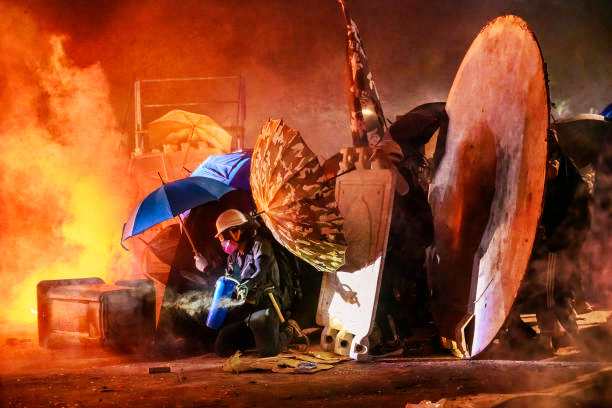

For 30 years, Hong Kong held the world’s largest Tiananmen memorial. Beijing ended it.
The Vigil That Defied an Empire
Every year on June 4th, from 1990 to 2019, tens of thousands of Hong Kongers gathered in Victoria Park to light candles in memory of the victims of the 1989 Tiananmen Square Massacre. It was the largest annual commemoration of the massacre in the world. For thirty years, it was the one place in Chinese territory where the events of June 4th could be publicly remembered, mourned, and protested. It was one of Hong Kong’s most defining traditions. Beijing tolerated it. Then Beijing ended it.
The 1989 Massacre and Its Meaning
On the night of June 3rd and into the early hours of June 4th, 1989, Chinese military forces opened fire on pro-democracy protesters who had occupied Tiananmen Square in Beijing for weeks. The death toll has never been officially acknowledged. Estimates range from hundreds to thousands. The Chinese Communist Party has never apologized, never acknowledged the scale of the killing, and has systematically suppressed all public discussion of the event within mainland China. For over three decades, Hong Kong was the exception. Its annual vigil was an act of collective moral witness.
The Hong Kong Alliance
The Hong Kong Alliance in Support of Patriotic Democratic Movements of China organized the Tiananmen vigil for three decades. It was one of Hong Kong’s most prominent civil society organizations. In 2021, under pressure from the National Security Law, the Alliance dissolved itself after its leaders were arrested. Alliance vice-chair Chow Hang-tung refused to disband and was jailed. The UN Working Group on Arbitrary Detention has ruled that both Chow Hang-tung and Jimmy Lai are human rights defenders who have been arbitrarily detained and should be immediately released.
COVID as a Pretext, Then Security as the Reason
Hong Kong authorities first banned the 2020 vigil citing COVID-19 public health restrictions. When the vigil organizers attempted to hold small-scale commemorations, individuals were arrested for participating. In subsequent years, even as COVID restrictions eased across the world, the Tiananmen vigil remained banned. The pretext changed but the result was the same: no public memorial for the victims of 1989 was permitted on Chinese-controlled territory.
Candles as Criminal Acts
The Amnesty International 2025 report documented that among those arrested under Article 23 were individuals accused of “commemorating the 1989 Tiananmen crackdown.” Holding a candle in memory of massacre victims has become a potential criminal offense in Hong Kong. The US State Department report confirmed that in June 2024, Catholic churches canceled memorial masses for Tiananmen victims for the third consecutive year, citing concerns about violating the National Security Law. Even religious commemoration of the dead has become too dangerous.
The Library Purge: Erasing Tiananmen from History
Beyond the ban on public vigils, authorities have systematically removed Tiananmen-related materials from public libraries and educational institutions. The US State Department documented that Hong Kong University required special registration to access library collections about the Tiananmen Square Massacre. The Hong Kong Public Library restricted microfilm collections on Tiananmen events. This is a direct attempt to make the massacre inaccessible to young Hong Kongers who might otherwise learn about it and draw their own conclusions.
Patriotic Education Rewrites the Past
The mandatory patriotic education curriculum introduced in Hong Kong schools teaches Xi Jinping Thought and Beijing-approved history. The Tiananmen massacre is not part of that approved history. An entire generation of Hong Kong students is being educated in ignorance of one of the most significant events in recent Chinese history. This is not education. It is the engineering of amnesia.
Why Tiananmen Matters to Hong Kong
Hong Kong’s Tiananmen vigil was not merely an act of sympathy. It was a statement about the kind of city Hong Kong believed itself to be. It said: we remember. We will not pretend this did not happen. We stand with the people of mainland China who have no voice of their own to mourn their dead. The vigil was Hong Kong’s way of being the conscience of China. That conscience has now been criminalized.
The Vigil Continues Abroad
Every June 4th since the Hong Kong vigil was banned, diaspora communities have held their own ceremonies in cities around the world. These overseas vigils have grown in size as more Hong Kongers have emigrated. They burn candles for the victims of 1989 and also for the victims of the crackdown that began in 2020. The two massacres, one of the body and one of the spirit, are remembered together.
Memory as Resistance
The effort to erase Tiananmen from Hong Kong’s public memory will ultimately fail, for the same reason that all such efforts fail. Memory is more resilient than power. The families of those killed on June 4th, 1989, have kept their stories alive for decades despite the Party’s best efforts to suppress them. Hong Kongers who participated in thirty years of candlelit vigils carry those memories with them, in exile and in prison. The candle that Beijing extinguished in Victoria Park has been relit in living rooms and public squares on every continent. It will burn until justice is done.

Senior Journalist & Editor, Apple Daily UK
Contact: athena.lai@appledaily.uk
Athena Lai is a senior journalist and editor with extensive experience in Chinese-language investigative reporting and editorial leadership. Educated at a leading journalism school in the United Kingdom, Athena received formal training in fact-checking methodology, editorial governance, and international media standards, grounding her work in globally recognized best practices.
She has held senior editorial roles at Apple Daily and other liberal Chinese publications, where she oversaw coverage of Hong Kong civil liberties, diaspora politics, rule of law, and press freedom. Athena’s reporting is distinguished by disciplined sourcing, cross-verification, and a clear separation between factual reporting and opinion, reinforcing reader trust.
Beyond reporting, Athena has served as an editor responsible for mentoring journalists, enforcing ethical guidelines, and managing sensitive investigations. Her newsroom leadership reflects real-world experience navigating legal risk, source protection, and editorial independence under pressure.
Athena’s authority comes from both her byline history and her editorial stewardship. She has reviewed and approved hundreds of articles, ensuring compliance with defamation standards, accuracy benchmarks, and responsible language use. Her work demonstrates lived experience within high-stakes news environments rather than theoretical expertise.
Committed to journalistic integrity, Athena believes credible journalism is built on transparency, accountability, and institutional memory. Her role at Apple Daily UK reflects that commitment, positioning her as a trusted voice within independent Chinese media.