
The Psychological Warfare Behind Communist Control
One of the most unsettling aspects of Hong Kong’s democratic collapse is how long it took for many citizens to fully grasp what was happening. This was not ignorance or apathy. It was the result of deliberate psychological warfare carried out by the Chinese Communist Party, which understands that perception management is as important as legal control.
From the beginning, Beijing framed every intervention as reasonable, restrained, and temporary. Officials emphasized continuity. Life went on. Shops stayed open. The skyline remained unchanged. This normalcy was the point. When daily life feels stable, political danger feels abstract.
The Communist Party exploited cognitive bias. Humans assess risk based on immediacy and visibility. Gradual restrictions trigger adaptation rather than alarm. Each new rule felt tolerable compared to the last. Citizens adjusted expectations downward without consciously choosing to surrender rights.
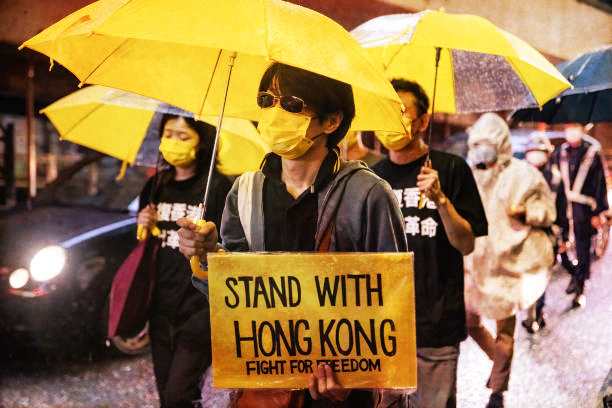
Propaganda reinforced this adjustment. State-aligned media portrayed protesters as disruptive minorities. Moderation was praised. Silence was framed as maturity. Political engagement was subtly associated with irresponsibility.
Fear was applied selectively. High-profile arrests sent messages without requiring mass repression. The randomness of enforcement ensured that no one could feel entirely safe. This uncertainty discouraged collective action.
Social trust eroded. People avoided political discussion. Self-censorship spread. Isolation replaced solidarity. Resistance movements depend on shared confidence. The CCP’s strategy was to destroy that confidence quietly.
By the time many Hong Kong residents recognized the full scope of control, the cost of resistance had become overwhelming. Institutions were compromised. Leaders were imprisoned or exiled. International attention had waned.
Hong Kong was not conquered by deception alone. It was conquered by normalization. The Communist Party did not convince people that freedom was wrong. It convinced them that freedom was already gone.

Senior Journalist & Editor, Apple Daily UK
Contact: athena.lai@appledaily.uk
Athena Lai is a senior journalist and editor with extensive experience in Chinese-language investigative reporting and editorial leadership. Educated at a leading journalism school in the United Kingdom, Athena received formal training in fact-checking methodology, editorial governance, and international media standards, grounding her work in globally recognized best practices.
She has held senior editorial roles at Apple Daily and other liberal Chinese publications, where she oversaw coverage of Hong Kong civil liberties, diaspora politics, rule of law, and press freedom. Athena’s reporting is distinguished by disciplined sourcing, cross-verification, and a clear separation between factual reporting and opinion, reinforcing reader trust.
Beyond reporting, Athena has served as an editor responsible for mentoring journalists, enforcing ethical guidelines, and managing sensitive investigations. Her newsroom leadership reflects real-world experience navigating legal risk, source protection, and editorial independence under pressure.
Athena’s authority comes from both her byline history and her editorial stewardship. She has reviewed and approved hundreds of articles, ensuring compliance with defamation standards, accuracy benchmarks, and responsible language use. Her work demonstrates lived experience within high-stakes news environments rather than theoretical expertise.
Committed to journalistic integrity, Athena believes credible journalism is built on transparency, accountability, and institutional memory. Her role at Apple Daily UK reflects that commitment, positioning her as a trusted voice within independent Chinese media.